
making
MAKING MEDUSA
from land and sea
Behind the artworks, unseen layers of gathering, preparation, and making draw together and transform the materials, defining the final form. These elements can be traced in the completed pieces.


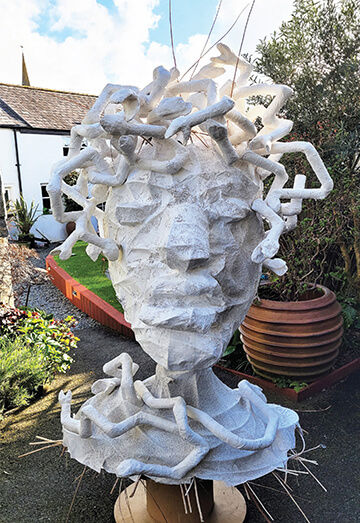

The littoral space, the transitional area between land and sea, was a creative starting point for this multipart work, influencing materials and construction. It is deeply connected to the wider site of the event, with its historical link to Jung’s conferences in Cornwall and to Medusa herself, who emerged from the sea and lived and died “beyond famed Oceanus at the world’s edge hard by Night.” ¹
This shifting, mercurial space influenced each aspect, from materials and construction to form and scale.
Where possible, the raw materials were sourced from this area, to be temporarily transformed, and returned to the sea, marking a pattern of change. These included willow, a natural material grown in wetlands in the South West of England, and seaweed washed ashore. A mix of biodegradable ‘media’ was sourced, as well as additional flotsam, recycled and construction materials, used as formers for elements destined to remain on land.
A process of gathering various seaweeds took place during the stormy winter prior to the event, involving trawling along the shoreline, sifting through washed-up remains from the tide, followed by sorting, grading, and laying the harvested material out to dry before it could be turned into a useable medium.
Much of the work was explored and came into focus through the different stages of making; imagining the sources, the stories, and the elements that would come together only at the final event. In this sense, Sarah links the process of ceremonial gathering, preparing, and development of the ritual to the story of La Loba, the ‘Bone Woman,’ ² embodying the archetype of the wild woman and the regenerative power of nature.
Working by hand, using traditional and intuitive methods, the forming of Medusa’s head dictated the imposing scale of the sculpture, the soaked brown willows bending only so far, reflecting the tension and drama of the myth. From the initial armature, layers of willow were added to strengthen the frame before the application of a thin layer of plaster bandages (Modroc) refined the surface and defined the facial details. Medusa’s crown of snakes was moulded with recycled tubing and Modroc to produce the interlocking snake hair.
For the beach ritual, delegates were invited to select a biodegradable seaweed snake —made with milled seaweed, water-soluble fishing tube, rice paper, and edible paint³—from the 'nest' surrounding the Medusa sculpture. Using food markers, participants wrote messages, statements, invocations and wishes onto these multi-coloured snakeskins.


REFERENCES & NOTES
01-03
references and notes
(01) Hesiod, “Theogony” 261-294 From translation: Hesiod “Theogony and Works and Days” Translated with an introduction and notes by M. L. West (1988), The World’s Classics, Oxford: Oxford University Press.
(02) See: Estés, C. P. (1992) ‘The Howl: Resurrection of the Wild Woman’, in “Women Who Run with the Wolves: Myths and Stories of the Wild Woman Archetype”, Ballantine Books, New York City, New York, The Random House Publishing Group, pp. 23–37.
(03) With thanks particularly to Mike and Sue Riley for helping to make the snakes required for the Medusa sculpture, as well as the biodegradable sea snakes for the workshop.
refs
images and galleries
01
seaweed sorting and laying (header image)
‘The process of gathering, sorting, laying and drying the seaweed’ (2023). Photograph: Sarah Hall (2023). Reproduced with permission.
02
building medusa's head in willow
‘Building Medusa's head using brown willow. Base from recycled drum.’ (2023). Photograph: Sarah Hall (2023). Reproduced with permission.
03
'skinning-up' the framework (side view)
‘Covering the Willow Framework with Modroc (plaster-bandage), side view.’ (2023) Photograph: Sarah Hall (2023). Reproduced with permission.
04
'skinning-up' the framework (front view)
‘Covering the Willow Framework with Modroc (plaster-bandage), side view.’ (2023) Photograph: Sarah Hall (2023). Reproduced with permission.
05
snake formers for medusa's crown
‘Snake Formers for Medusa's Hair’ (2023) Recycled Foam Insulation Tubes, Tape. Photograph: Sarah Hall (2023). Reproduced with permission.
06
forming snakes for medusa's crown (detail)
‘Detail of Snake Form, for Medusa's Hair’ (2023) Snake former with Modroc (plaster bandage) Modelled Coating. (Please note that only the ‘sea-biodegradable snakes’ were returned to the sea). Photograph: Sarah Hall (2023). Reproduced with permission.
07
fitting snakes to medusa's head (back view)
‘Fitting Snakes to Medusa's Head (back view).’ (2023) Head form with ‘Snake Crown’ partially attached (White Modroc (Plaster) Coating). (Please note that only the ‘sea-biodegradable snakes’ were returned to the sea). Photograph: Sarah Hall (2023). Reproduced with permission.
08
painting medusa's head
‘Painting Medusa's Head (front view).’ (2023) Head form with ‘stone effect’ paint, (referencing sand and stone). (Please note that only the ‘sea-biodegradable snakes’ were returned to the sea). Photograph: Sarah Hall (2023). Reproduced with permission.
09
chopped-up dried seaweed (details)
‘Details of Chopped Dried Seaweed’ (2023). Mechanically shredded to achieve fine consistency. Photographic sequence: Sarah Hall (2023). Reproduced with permission.
10
laying and sorting the gathered seaweed
‘Laying and sorting the gathered seaweed’ (2023). Mix of local seaweed species. Photograph: Sarah Hall (2023). Reproduced with permission.
11
chopping up the dried seaweed
‘Chopping the Dried Seaweed’ (2023). Mechanically shredded to achieve fine consistency. Photograph: Sarah Hall (2023). Reproduced with permission.
12
biodegradable tubing to form snakes
‘Biodegradable Tubing to Form Snakes’ (2023) Water-soluble and biodegradable tubing developed for carp fishing. Photograph: Sarah Hall (2023). Reproduced with permission.
13
funnelling seaweed into dissolving tube ‘snakes’
‘Filling the seaweed snakes’ (2023). A funnel and tube system to fill the biodegradable tubing with the finely shredded seaweed. Photograph: Sarah Hall (2023). Reproduced with permission.
14
forming and coating snakes with rice paper
‘Forming and Coating Biodegradable Snakes with Rice Paper’ (2023). Adding shape, strength and definition with rice paper. Final snakes are baked. Photograph: Sarah Hall (2023). Reproduced with permission.
15-16
colouring the snakes with edible paint
‘Colouring Completed Seaweed Snakes with Edible paint’ (2023). Photograph: Sarah Hall (2023). Reproduced with permission.